Opinion · Dubai & Morocco · Retirement
Retiring in Dubai or Morocco?
I hear this question more and more, often from Moroccans who worked thirty years in Europe or Canada and whose children have since moved to the Gulf. I am Ahmed Benjas, a Moroccan real estate agent in Dubai, with more than twenty years in finance before property. Here is how I read it, without the brochure.
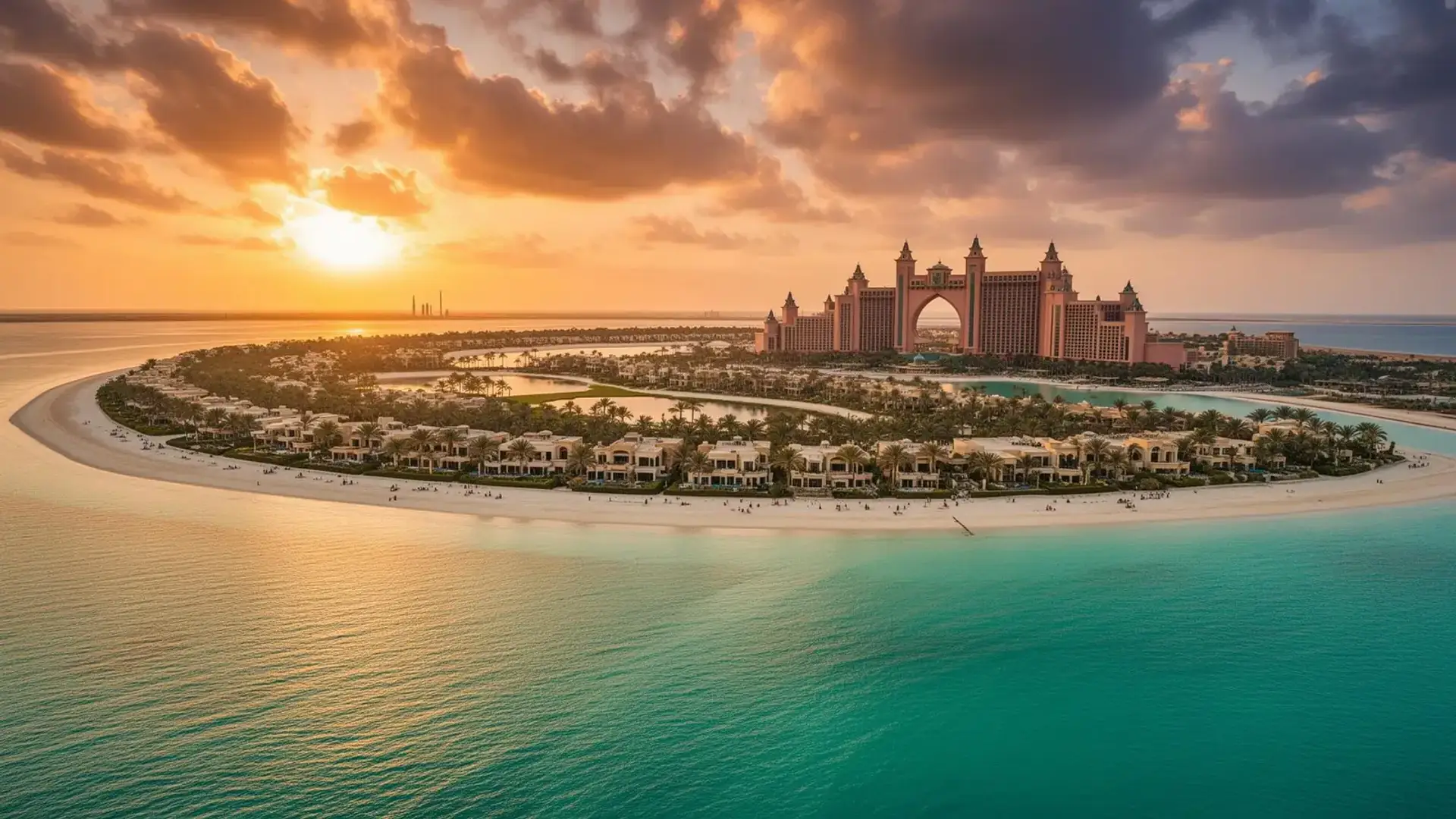
Palm Jumeirah, DubaiMy short answer
For most Moroccans abroad, Morocco remains the most logical base for retirement: the family is there, the language is yours, you need no residence permit (you are at home), and the tax system rewards bringing foreign pensions back. Dubai makes sense in specific cases: your children live there, your pension or your savings are high, and you want a dollar-linked environment with top-level private healthcare, accepting that it comes at a price.
The points that tip the balance, according to the official texts:
- In the UAE, the residence visa for the retired lasts 5 years, from age 55, with at least 15 years of work, plus wealth or income conditions published on u.ae
- In Morocco, the tax due on a foreign-source pension benefits from an 80% reduction on the part transferred permanently in non-convertible dirhams (article 76 of the Code général des impôts)
- The UAE dirham is pegged to the US dollar; the Moroccan dirham is managed by Bank Al-Maghrib against a euro/dollar basket: a pension paid in euros does not carry the same currency risk in the two countries
- Many families combine both: main home in Morocco, long stays with the children in Dubai, and a property in one country or the other depending on the goal
The UAE retirement visa: what the conditions say
The official u.ae portal describes a five-year residence visa for retirees. You must be at least 55 at retirement and have worked for at least 15 years, in the UAE or elsewhere. You then need to meet one of two financial conditions:
- Wealth: own one or more properties worth at least AED 1 million and hold savings of at least AED 1 million, as the u.ae page presents them
- Income: an annual income of at least AED 180,000, or its equivalent in foreign currency, from a UAE or foreign source
- In Dubai: u.ae states that for an application filed from Dubai, the fixed annual income must not be less than AED 240,000
I read these thresholds as a financier: they are eligibility minimums, not a living budget. They are revised from time to time, and the way they are applied can vary by emirate and by the authority handling the file. Before you build a retirement plan around the visa, have the conditions confirmed for the year you apply.
Two points people often miss. The visa is renewable under conditions, so your right to stay depends on still meeting them in five years. And a UAE residence visa does not by itself end your tax residence in the country you live in today. If your property holdings reach AED 2 million, the ten-year Golden Visa is another route, which I cover in the Golden Visa for Moroccans.
Your pension: where is it taxed, and what is left?
This is often where the decision is made. In Morocco, article 76 of the Code général des impôts grants a reduction equal to 80% of the tax due on a foreign-source pension, for the part transferred permanently in non-convertible dirhams. In practice, the Moroccan bank issues a certificate of the amounts received in foreign currency and their value in dirhams, and the retiree files an income tax return every year. No return and no certificate, no reduction.
Morocco must also have the right to tax that pension in the first place. That depends on the tax treaty between the country paying the pension and Morocco. For France, the general rule of the French-Moroccan treaty separates private pensions, taxable in the country of residence, from public-sector pensions, taxed in France. The texts are published on impots.gouv.fr; your pension fund and an adviser confirm your own case. If your pension comes from Belgium, the Netherlands, Canada or the UK, the same question applies under that country's treaty with Morocco.
The UAE has no federal personal income tax. But do not jump to the conclusion that your pension will be "tax-free" there: the paying country may keep a right to tax it, depending on its treaty with the UAE and on the type of pension. It is the question I always ask clients to have settled in writing before they move.
Currency: the risk nobody prices in
A retirement lasts twenty or thirty years. Over that span, the currency your pension is paid in matters as much as its amount. The UAE dirham is pegged to the US dollar at AED 3.6725 per USD 1, a fixed rate maintained by the Central Bank of the UAE. A euro pension spent in Dubai therefore follows the euro against the dollar.
The Moroccan dirham is managed by Bank Al-Maghrib against a basket made up of 60% euro and 40% dollar, within a fluctuation band of plus or minus 5%. A euro pension spent in Morocco is therefore, mechanically, less exposed to currency swings than in Dubai. This is not a forecast: it is how the two exchange-rate regimes are built.
My comparison grid
This is the grid I go through with a client preparing retirement. It does not name a winner: it shows where the trade-offs are.
| Criterion | Dubai | Morocco | What I look at |
|---|---|---|---|
| Right to stay | 5-year retirement visa under conditions (u.ae), or Golden Visa through property | Nothing to apply for as a Moroccan | Your ability to renew the visa in 5 and 10 years |
| Tax on the pension | No federal personal income tax; the paying country's rights to check | Moroccan scale, with an 80% reduction on foreign pensions transferred (art. 76 CGI) | The tax treaty that applies to your pension |
| Currency | AED pegged to the dollar | MAD on a euro/dollar basket | The currency of your pension and of your spending |
| Health | Health insurance mandatory in Dubai; cost rises with age | Public system and private clinics; cover to organise | The insurance cost at 70 and 80, not at 55 |
| Housing | Rent or buy; a property of at least AED 1M in one of the visa routes | Family home, purchase or renovation | Not locking all your savings into bricks |
| Family | Close to the children if they live in the Gulf | Close to the wider family | Where the grandchildren will be in ten years |
| Succession | Property in Dubai: to be organised in advance | Family Code rules for Moroccan Muslims | A written plan, country by country |
Worked example: a euro pension against the UAE threshold
A fictitious case, built to show the method. A 62-year-old Moroccan, retired in France after a career of more than fifteen years, receives a total pension of €2,500 a month, or €30,000 a year. His daughter lives in Dubai. He asks me whether he can settle there on the retirement visa.
- At a hypothetical rate of AED 4 to €1 (the real rate changes every day), his pension comes to AED 120,000 a year.
- That is below the AED 180,000 income threshold, and further still below the AED 240,000 stated for an application filed from Dubai.
- The income route is closed. The wealth route remains: a property of at least AED 1 million and savings of at least AED 1 million, as u.ae presents it. If he has neither, Dubai stays a destination for long family stays, not a place of residence.
- In Morocco, the same pension, if Morocco may tax it under the treaty and it is transferred permanently in non-convertible dirhams, qualifies for the 80% reduction on the corresponding tax. He keeps his right to stay, his family, and a pension less exposed to currency swings.
My conclusion, for him: a base in Morocco, regular stays in Dubai, and no purchase in Dubai "for the visa" if it would take all his savings. With a pension twice as large and substantial savings, the answer would be different. That is the whole point of running the numbers before dreaming.
Buy, rent or keep: the property question
In retirement, your home is no longer an investment like any other: it is where you live, and it must stay simple to run. In Morocco, many retirees already have the family house, or buy a more practical flat; the costs of a purchase are set out in property buying costs in Morocco, and the process from abroad in buying in Morocco from abroad.
In Dubai, I almost always advise renting first, for at least a year, before buying a home to live in: you discover the summer climate, the neighbourhood, the distance to the children. My grid is in moving to Dubai: buy or rent (in French). If the purchase also serves the visa, the property must first be a good property: easy to resell, with service charges you can carry. For the projects we follow, Cevitas's page on Golden Visa eligible property in Dubai sets out the buyer's side.
The risks I put on the table
I would rather name them before my clients discover them:
- Visa renewal: in Dubai, your right to stay depends on financial conditions checked at each renewal. A drop in income or the sale of the property can call it into question.
- Health with age: health insurance is mandatory for Dubai residents (Dubai Health Authority), and its cost rises with age and medical history. Ask for quotes at 70 and 80, not only at 55.
- Tax in the country you leave: leaving France, Belgium or Canada has consequences (pension, accounts, remaining assets) that are settled before departure, not after.
- Currency: a euro pension gains or loses purchasing power in Dubai with the euro against the dollar.
- Succession: a property in Dubai follows rules you need to organise during your lifetime; I explain them in succession of a property in Dubai (in French).
- Isolation: it is not a number, but it is the first reason for coming back that I hear. Retirement is lived where you have ties.
What I tell my clients
I always start with three questions. Where will your children and grandchildren live in ten years? In which currency is your pension paid? What share of your savings are you ready to lock into property? The answers decide faster than any "best country to retire" ranking.
And I remind them that it is not a binary choice. The combination I see most often works well: residence in Morocco, tax settled in Morocco with the reduction designed for foreign pensions, and Dubai for the family and, when the savings allow, a property that earns its keep. For the overall logic, read Dubai or Morocco: how to choose; for tax on the UAE side, property taxation in Dubai.
My role
I am a RERA-licensed broker in Dubai (BRN 83239), co-founder & CEO of Cevitas Real Estate (ORN 49294), with more than twenty years in finance before property. I am neither a tax adviser nor a lawyer: on tax and the applicable treaty, I point you to the right people. My job is to lay the property and currency numbers flat, so that the decision is yours.
All my pages for the diaspora are on property for Moroccans around the world. If you are preparing a retirement between the two countries, write to me with your country of residence, the currency of your pension and your time horizon: that is where we start.
Your roadmap
Your project, in 60 seconds.
Five questions, and I reply personally with a first reading of your project: where, how, and in what order.
- A personal reply from Ahmed
- A free 30-minute call
- No commitment
Step 1 of 5
Where do you live today?
Official sources
- Official UAE Government portal (u.ae) · Residence visa for the retired
- Direction générale des impôts (DGI, Morocco) · Code général des impôts, article 76
- impots.gouv.fr · International tax treaties (France)
- Central Bank of the UAE · dirham peg to the US dollar
- Bank Al-Maghrib · exchange rate regime and reference rates
- Dubai Health Authority · health insurance
FAQ
Frequently asked questions
How old do you need to be for the UAE retirement visa?
According to the official u.ae portal, you must be at least 55 at retirement and have worked for at least 15 years, in the UAE or abroad. You must also meet a wealth or an income condition. The visa is granted for five years and is renewable under conditions.
What income do you need to retire in Dubai on this visa?
u.ae states an annual income of at least AED 180,000, or its foreign-currency equivalent, and specifies that for an application filed from Dubai the fixed annual income must not be less than AED 240,000. These thresholds can change: check them the year you apply.
How does Morocco's 80% reduction on a foreign pension work?
Article 76 of the Code général des impôts grants a reduction equal to 80% of the tax due on a foreign-source pension, for the part transferred permanently in non-convertible dirhams. You must file a tax return every year and attach the certificates from your bank and from the body that pays the pension.
Does a UAE retirement visa make me tax resident in the UAE?
Not automatically. A residence visa gives you the right to live in the UAE; your tax residence is decided by the rules of each country concerned and by the treaties between them. Settle it with a tax adviser before you leave your current country, so that you do not end up with two tax residences, or none you can prove.
Do I have to buy a property in Dubai to retire there?
No. The retirement visa can also rest on income, and many retirees rent first. If the purchase serves the visa, the property must remain a sound investment, easy to resell, without locking up all your savings.
Can I split my retirement between Dubai and Morocco?
Yes, it is the pattern I see most often: residence and tax in Morocco, stays with the children in Dubai. You just need to know where your tax residence is and avoid creating two without meaning to.
Read next
Contact
Let's talk about your project.
One message is enough. I reply personally, in English, French, Arabic or Darija.