Insight · Moroccans in the UAE · Tax
Living in Dubai, and still taxed in Morocco?
"I live in Dubai, so I no longer pay anything in Morocco." I hear that sentence every week. Sometimes it is true, often it is incomplete. I am Ahmed Benjas, a Moroccan broker based in Dubai with a background in finance: this is how I walk Moroccans in the UAE through the tax residency question, with the official texts in hand.
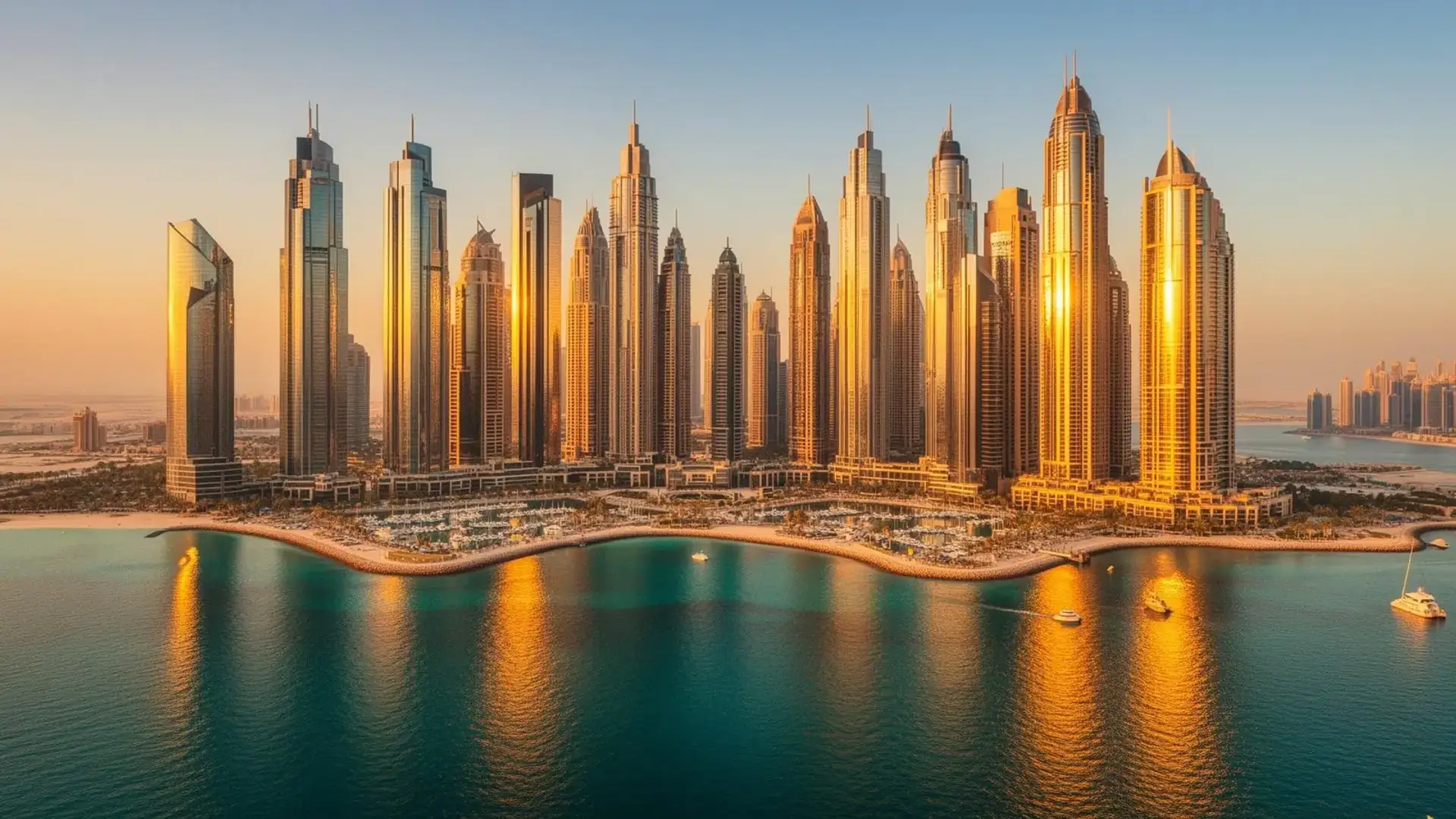
Dubai towers by the waterThe short answer
Your tax residency does not depend on your visa, nor on the address in your passport. It depends on criteria set by each country, and those criteria can overlap. A Moroccan working in Dubai can be a UAE tax resident and, at the same time, remain a Moroccan tax resident if their family or their economic interests stayed in Morocco.
- In Morocco, you are a tax resident if you have your permanent home there, or the centre of your economic interests, or if you stay there more than 183 days in any 365-day period (General Tax Code, article 23). One criterion is enough
- As a resident, you are taxable in Morocco on your worldwide income; as a non-resident, only on your Moroccan-source income
- In the UAE, the criteria are set by Cabinet Resolution No. 85 of 2022, applicable since 1 March 2023 (183 days, or 90 days under conditions, or principal residence and centre of interests)
- Whatever your status, rent and capital gains from a property located in Morocco remain taxable in Morocco
What Morocco's General Tax Code says
Article 23 of the General Tax Code published by the DGI, Morocco's tax directorate, separates two situations. People with their tax domicile in Morocco are taxable on all their income, from Moroccan and foreign sources. People without a tax domicile in Morocco are taxable only on their Moroccan-source income.
The same article defines tax domicile with three criteria, and any one of them is enough: having your permanent home (foyer d'habitation permanent) in Morocco; having the centre of your economic interests there; or staying there, continuously or not, for more than 183 days in any 365-day period.
This is where many Moroccans in the UAE get it wrong. They count their days, see that they spend less than six months a year in Morocco, and conclude they are non-residents. But if the spouse and children live in Casablanca in the family home, the permanent home question arises, whatever the number of days.
What the UAE says
On the UAE side, Cabinet Resolution No. 85 of 2022 sets out three ways for an individual to be a tax resident. Again, one is enough.
| UAE test | Condition | Documents requested for the FTA certificate |
|---|---|---|
| 183 days | Physically present for at least 183 days in a consecutive 12-month period | Emirates ID, or passport with an official entry and exit report |
| 90 days | At least 90 days in a 12-month period, with a valid residence permit (or UAE or GCC nationality), plus a permanent place of residence, or employment, or a business in the UAE | Emirates ID, passport and entry/exit report, plus proof of the job, business or home |
| Principal residence | Usual or primary place of residence and centre of financial and personal interests in the UAE | Emirates ID, passport and entry/exit report, proof of residence and interests, source of income where relevant |
Being a UAE tax resident does not automatically make you a non-resident of Morocco. Each country applies its own law, independently. When both treat you as resident, the tax treaty between them is what breaks the tie.
The Morocco–UAE treaty and the residency certificate
According to the UAE Ministry of Finance's official list, the double taxation agreement on income between the UAE and Morocco was signed on 9 February 1999 and has been in force since July 2000. Like most treaties, it allocates the right to tax each type of income and sets out how to decide the residence of someone both countries claim. Its tie-breaker runs in a fixed order: permanent home first, then centre of vital interests, then habitual abode, then nationality. The article-by-article reading for a property owner is in the Cevitas Real Estate guide to the Morocco–UAE tax treaty and a property in Dubai. For your own case, have the text read by a tax adviser: that is their job, not mine.
To claim the treaty, the key document is the Tax Residency Certificate issued by the Federal Tax Authority. According to the official service page: AED 50 application fee, AED 1,000 review fee for an individual without a corporate tax registration number, AED 250 per printed copy, and a stated review time of ten working days. The certificate covers a period of at most 12 months chosen by the applicant, and never a future period.
Worked example: two Moroccans in Dubai, two answers
Fictitious cases, built to illustrate the criteria. Neither is a client. Both are engineers in Dubai with a UAE residence permit, and both own an apartment in Casablanca.
| Youssef | Karim | |
|---|---|---|
| Days in the UAE over 12 months | 290 | 200 |
| Days in Morocco over 12 months | 45 | 130 |
| Family | Wife and children in Dubai | Wife and children still in Casablanca |
| Casablanca apartment | Let all year | Lived in by the family |
| UAE 183-day test | Met | Met |
| Moroccan 183-day test | No | No |
| Permanent home in Morocco? | Unlikely | A serious question: the family lives there |
| Likely reading | UAE resident, non-resident of Morocco: Moroccan tax on the Casablanca rent only | Possible dual residence: to be settled under the treaty, FTA certificate in hand, with a tax adviser |
What I take from these two cases: counting your days is necessary, but not sufficient. The criterion that tips the balance is often human (where the family lives) or economic (where the income and the main assets are).
What Morocco taxes whatever your status
Even if you are clearly a non-resident, a property located in Morocco produces Moroccan-source income. Three cases come up again and again with Moroccans in the UAE:
- Rent from an apartment in Morocco is taxable in Morocco, on the same scale as for an owner who lives there. The calculation and the return are covered in renting out property in Morocco while living abroad.
- Selling a property in Morocco triggers the tax on real estate profit: 20% of the net gain, with a minimum of 3% of the sale price, unless an exemption applies. The main home exemption can cover the family home kept back home, under precise conditions that I explain in selling property in Morocco as a non-resident.
- Local taxes attached to the property (housing tax, municipal services tax) follow the property, not where you live.
The resident versus non-resident distinction therefore matters mostly for your other income: a salary paid in Dubai, rent from a Dubai property, investments. A Moroccan tax resident is in principle taxable in Morocco on that foreign income, subject to the treaty. A non-resident is not.
And your property in Dubai?
In the UAE, an individual investing in their own name, without a commercial licence, is not subject to corporate tax on rent or capital gains, whatever the amount (Cabinet Decision No. 49 of 2023). Dubai Land Department fees at purchase, service charges and management fees still apply: I break them down in Dubai property taxes and costs.
Beware of circular reasoning, though: "no tax in Dubai" does not mean "no tax at all". If you remained a Moroccan tax resident, the rent from your Dubai apartment falls in principle within the scope of Moroccan tax, and the treaty decides who may tax it. That is exactly Karim's situation in the example above.
MRE at the bank, resident for tax: two different notions
Your status at a Moroccan bank (convertible dirham account, MRE status) is governed by the exchange regulations of the Office des Changes. Your tax residency is governed by the General Tax Code. The two do not always line up. Opening a non-resident account does not make you a tax non-resident, and the reverse is true as well.
For transfers between the two countries, keep every proof of where the funds came from: that is what later allows the proceeds of a sale in Morocco to be transferred back abroad. On the Dubai side, I explain it in transferring money to buy in Dubai.
My view: what I tell Moroccans who move to Dubai
I am not a tax adviser. But after twenty years in finance and then real estate, I have seen enough files to know where things get stuck. My checklist:
- Decide your situation, do not let it happen to you. If your family stays in Morocco, assume the permanent home question will be asked, and get it settled in writing before buying a rental property in Dubai.
- Request the FTA Tax Residency Certificate for each year you need it, over the right 12-month period. It is the document that lets you invoke the treaty.
- Keep a file of evidence: Dubai lease or title deed, employment contract, entry and exit report, the children's school records. That is what you will be asked for if your status is challenged.
- Do not use your Moroccan property at random. Letting it or leaving it to the family changes the tax on a future sale. Decide its use from the start.
- If you lived in Europe before Dubai, check that country's exit rules too: France and the United Kingdom, for instance, have their own residence tests.
For a Moroccan living in the UAE who is thinking of buying in Dubai, the buying process itself is described in buying property in Dubai as a UAE resident. If you are weighing where to settle for the long run, my comparison retiring in Dubai or Morocco looks at the same question from the other end.
The risks to keep in mind
I prefer to name them plainly:
- An ignored dual residence: two tax administrations that each consider you their resident, and income declared nowhere, or everywhere.
- A certificate requested too late or for the wrong period: it never covers a future period, nor more than 12 months.
- Rules that move: Moroccan finance laws, UAE ministerial decisions. Have your situation reviewed every year it changes (marriage, the family moving back, a new job). If you are preparing a permanent return, read also moving back to Morocco: keep or sell your Dubai property.
- General guidance applied to a specific case: this page helps you ask the right questions, it does not replace a tax adviser.
My role
I am a RERA-licensed broker in Dubai (BRN 83239), co-founder & CEO of Cevitas Real Estate (ORN 49294), with more than twenty years in finance before real estate. For a Moroccan in the UAE, I prepare the property side of the file: which property, in whose name, for what use, which documents to keep, and the precise questions to put to your tax adviser before you sign.
All my pages for the diaspora are on property for Moroccans abroad, and the Moroccans in the UAE and the Gulf page brings the rest together. Write to me with your situation (family, days, properties): that is where we start.
Your roadmap
Your project, in 60 seconds.
Five questions, and I reply personally with a first reading of your project: where, how, and in what order.
- A personal reply from Ahmed
- A free 30-minute call
- No commitment
Step 1 of 5
Where do you live today?
Official sources
- Direction générale des impôts (DGI, Morocco) · General Tax Code, article 23 (territoriality, tax domicile)
- UAE Legislation · Cabinet Resolution No. 85 of 2022 on tax residency
- Federal Tax Authority (UAE) · Tax Residency Certificate
- UAE Ministry of Finance · Double taxation agreements on income (list)
- UAE Ministry of Finance · Cabinet Decision No. 49 of 2023
- Office des Changes (Morocco) · exchange regulations
FAQ
Frequently asked questions
I have lived in Dubai for two years: am I still a Moroccan tax resident?
Not necessarily, but not automatically a non-resident either. Under article 23 of Morocco's General Tax Code, you remain a resident if you have your permanent home or the centre of your economic interests in Morocco, or if you spend more than 183 days there in any 365-day period. One criterion is enough.
Is spending fewer than 183 days in Morocco enough to stop being taxed there?
No. The number of days is only one of the three Moroccan criteria. If your family lives in your home in Morocco, or most of your income and assets are there, you can remain a Moroccan tax resident.
How do I prove I am a UAE tax resident?
With the Tax Residency Certificate from the Federal Tax Authority. According to its official page, it costs AED 50 to apply and AED 1,000 for the review for an individual without a corporate tax number, and it covers at most 12 months, never a future period.
Is the rent from my apartment in Morocco taxed if I live in Dubai?
Yes. It is Moroccan-source income, taxable in Morocco whether you are resident or not, on the same scale as an owner living in Morocco.
Is my rented-out apartment in Dubai taxed in the UAE?
An individual investing in their own name, without a commercial licence, is not subject to corporate tax on rent or capital gains (Cabinet Decision No. 49 of 2023). If you remained a Moroccan tax resident, however, that rent may concern the Moroccan tax authority, depending on the treaty.
Does a UAE Golden Visa make me a UAE tax resident?
Not by itself. A residence permit is one condition of the UAE 90-day test, alongside the days and a home, job or business in the UAE; the 183-day and principal residence tests do not depend on the visa type. And on the Moroccan side, article 23 ignores your visa altogether.
Read next
Contact
Let's talk about your project.
One message is enough. I reply personally, in English, French, Arabic or Darija.